America’s drone advantage will not be decided by inventory alone. The transfer of the Top Drone program from the Pentagon’s research and engineering office to the U.S. National Drone Association creates a recurring interservice venue to identify operators, compare tactics, and expose where equipment or doctrine fails under realistic pressure.
The distinction matters. Drone Dominance is building a supply pipeline for small, lethal systems. Top Drone can build the human-performance pipeline around them. If its standards are rigorous, competition becomes readiness infrastructure, not a showcase. And whether it works will depend less on the aircraft than on the software that records, scores, and learns from every run.
What changed on September 16
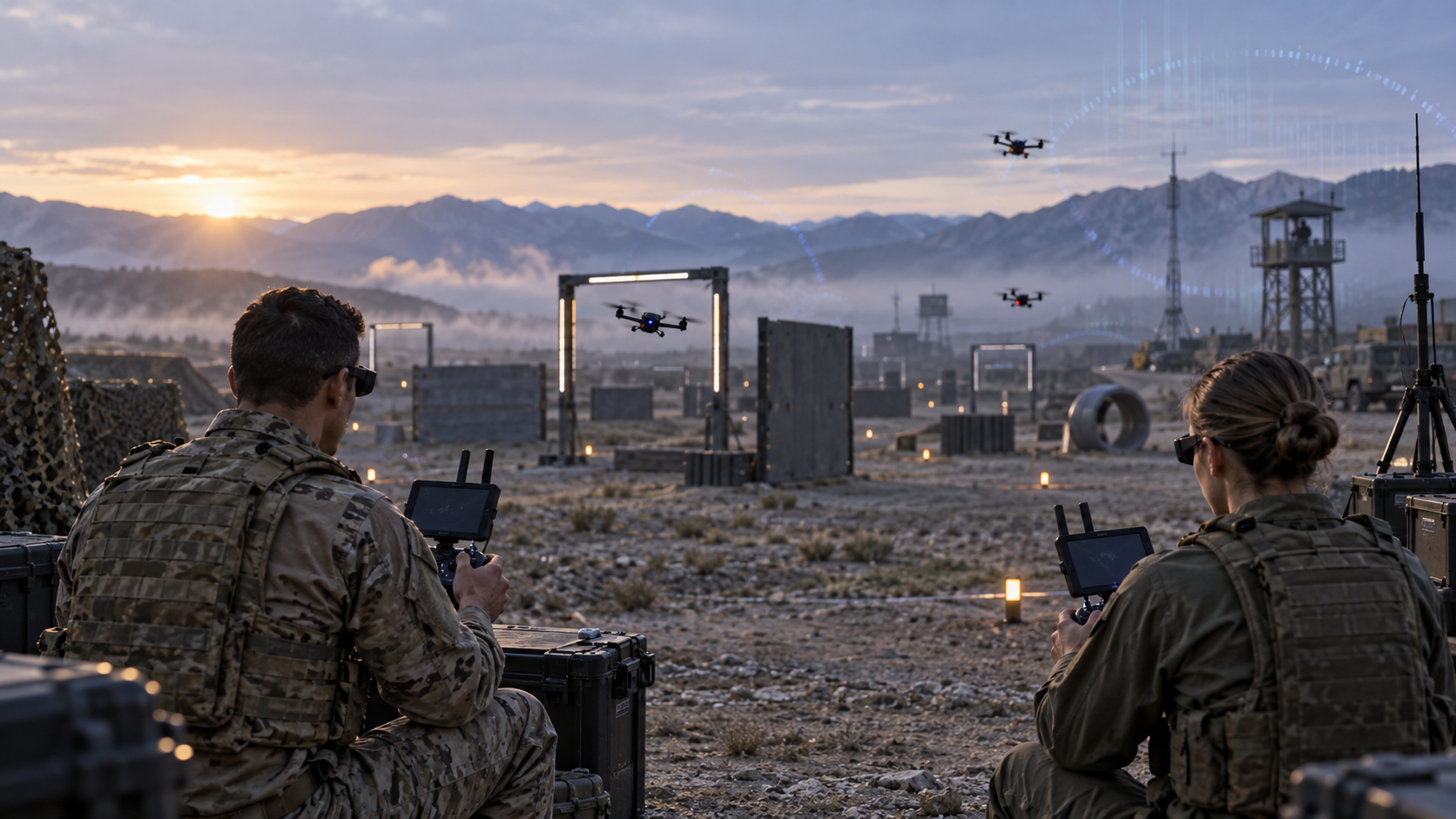
The announced handoff moves Top Drone from a one-time Pentagon demonstration toward a standing program. The event first ran during T-REX 25-2 in August 2025. USNDA’s National Drone Wars and Drone Crucibles are now designated as the primary venue for identifying top operators from the military’s rank and file.
DefenseScoop reported that the research and engineering office affirmed the arrangement. The competition model is intended to test pilots under electronic-warfare stress, across varied terrain, and in offensive and defensive missions. An interservice, operator-led advisory group administered by USNDA will establish the criteria.
The announced field has three classes:
- Service academies, including the U.S. Naval Academy and West Point.
- Conventional forces, including Army and Marine Corps units.
- Special operations forces, including Army Rangers, Naval Special Warfare, and Marine Forces Special Operations Command.
USNDA announced an overseas Drone Crucible in Germany for November 2026 and a National Drone Wars championship at an undisclosed continental U.S. installation in the first quarter of 2027. Qualification criteria, entry standards, and registration are scheduled for publication on the Drone Dominance website in October 2026. As of October 1, they are not yet public.
Why the operator is becoming the limiting system
The Pentagon’s Drone Dominance program describes a $1 billion, two-year plan intended to purchase more than 200,000 small lethal drones by 2027. Its Gauntlet events evaluate systems and create production demand. That scale changes the problem: buying aircraft is no longer enough. Units need operators who can employ them under spectrum denial, coordinate sensing and effects, recover from failure, and adapt tactics faster than an adversary.
The Army has already demonstrated the value of separating platform performance from operator performance. Its inaugural Best Drone Warfighter Competition used a common baseline drone in one lane to isolate pilot skill, while allowing teams to bring compliant systems in a tactical hunter-killer lane. More than 200 competitors participated across racing, tactical, and innovation challenges.
Top Drone will need the same discipline at interservice scale. A score that blends aircraft quality, operator proficiency, mission design, and unit resources into one number cannot reveal what to fix.
Is the program identifying the best pilot, the best team, the best system, or the best combined combat capability? Each is useful. Each requires different controls, evidence, and scoring.
Competition can become a readiness operating system
A recurring competition can perform four institutional functions at once:
- Discover talent that conventional personnel systems do not reliably surface.
- Create a common proficiency baseline across services and force types.
- Accelerate the exchange of tactics, techniques, and procedures between units.
- Feed operator evidence back into training priorities, acquisition decisions, and product design.
USNDA’s own September 2025 Drone Crucible after-action report is candid about the starting point. The inaugural event was designed as a crawl stage and was not objectively graded because service maturity, authorities, funding, and system access varied too widely. Teams received qualitative feedback while organizers captured common capability gaps.
That transparency is an advantage. The next phase is to preserve operational context while making performance comparable enough to drive decisions. Standardization should expose readiness gaps without erasing the conditions that produced them.
The software and data layer will decide whether this scales
The most important Top Drone infrastructure may not fly. It will record what happened, under which conditions, with which configuration, and with what result. Without that evidence chain, each event resets institutional memory.
Top Drone becomes strategically valuable when every event produces auditable, reusable evidence: mission definitions, telemetry, video, system configuration, evaluator observations, safety events, and after-action decisions. AI can help find patterns and assemble reviews, but accountable operators must control scoring and release decisions.
A credible digital backbone should provide:
- Mission-level scoring that distinguishes speed, effect, survivability, electronic-warfare resilience, coordination, safety, and operator workload.
- Evidence packages that bind scores to telemetry, video, configuration, and evaluator notes.
- Portable records that support comparison across services and events while enforcing classification, privacy, and need-to-know boundaries.
- A closed-loop path from observed gap to training change, acquisition action, doctrine update, or next-event test.
Where AI earns a place in the after-action loop
A single competition day can generate hours of first-person video, flight logs from dozens of airframes, spectrum recordings, and pages of evaluator notes. Humans cannot review all of it before the next event, which is exactly why lessons get lost between iterations. This is a strong fit for AI, provided the system is built around evidence rather than impressions.
Useful jobs for models here are concrete:
- Aligning video, telemetry, and jamming windows on one timeline so evaluators review the moment a link degraded, not the whole sortie.
- Tagging recurring failure patterns across teams, such as lost links at a specific range or repeated collisions at a gate.
- Drafting after-action summaries that cite the exact clip and log segment behind each finding.
Three controls keep that useful rather than dangerous. Models do not assign scores; they surface evidence for human judges. Every generated finding links back to its source data, so a reviewer can check it in seconds. And the same records stay inside the classification and privacy boundaries the program sets, with access enforced by the system rather than by policy memos. Built that way, AI shortens the gap between an event and the training change it should produce. Built carelessly, it becomes one more opaque score.
Three tests will determine credibility
- Repeatability: Can the same mission and scoring model produce comparable results across ranges, services, and aircraft classes?
- Actionability: Do findings reach commanders, schools, program offices, and vendors in a form that changes training or equipment?
- Independence: Are competition rules and evidence controls strong enough to keep vendor participation from shaping the yardstick?
The broader policy direction is established. Executive Order 14307 calls for faster testing, domestic production, secure supply chains, and expanded access to training. The Top Drone transition is the personnel-and-learning complement to that industrial push.
What to watch next
This month’s qualification and scoring criteria will reveal whether Top Drone is primarily a championship, a force-wide certification mechanism, or a combined experimentation system. The Germany event will show how allied participation is handled. The first-quarter 2027 championship will test whether the model can compare performance across service academies, conventional forces, and special operations without flattening their different missions.
The strategic opportunity is clear: turn competition data into a continuously improving map of people, tactics, and systems. America’s top drone talent will matter most when the institution can find it, learn from it, and reproduce it across the force.