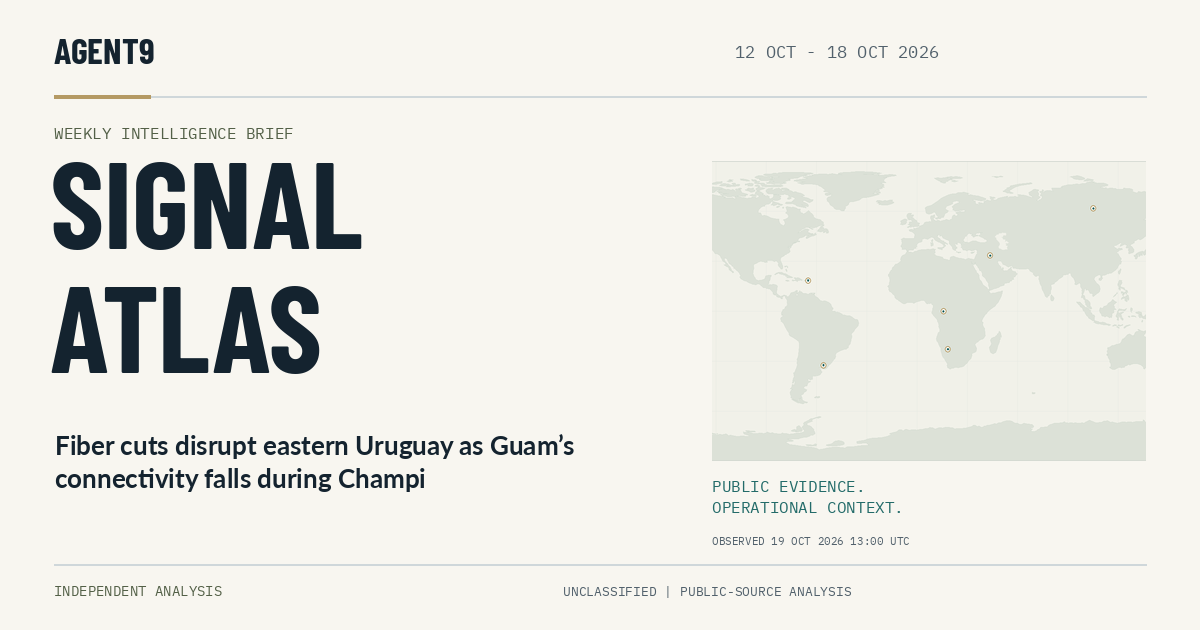
During October 12 to 18, archived measurements captured disruptions associated with damaged fiber, electricity failures and Typhoon Champi, alongside an open Yandex record carried over from the previous week. These Radar and IODA records are the supplied frozen evidence packet; live landing pages do not independently reproduce its historical findings. Antel explained Uruguay’s disruption, while government reporting documented uneven power availability in Guam. Namibia and the U.S. Virgin Islands show why electricity and internet recovery need separate timelines. Digicel and Biznet acknowledged service problems; other signals remain unexplained. All five outage records and 23 anomalies are covered. [1] [4] [2] [5] [6]
Uruguay’s overlapping records describe one disruption. Antel’s account of four fiber cuts supports Radar’s cable-cut classification. The operator’s repair chronology and Radar’s traffic window describe different aspects of the incident. [1] [4]
Guam’s power losses were uneven. Archived Radar and IODA signals indicate connectivity losses. Guam officials reported that approximately 51% of electricity distribution circuits remained online, explicitly ruling out a system-wide power blackout. [1] [2] [5]
Power and internet clocks differ. Namibia’s reported power interruption lasted 18 minutes; Radar’s traffic record spans 15. Neither interval should replace the other, and country-level measurements do not establish every operator’s experience. [1] [2] [6]
Several leads remain unexplained. Concurrent Iraqi signals, three separate Republic of the Congo anomalies and six other network records lack verified explanations for their specific windows. Identical start and end timestamps in three records leave duration undetermined. [1]
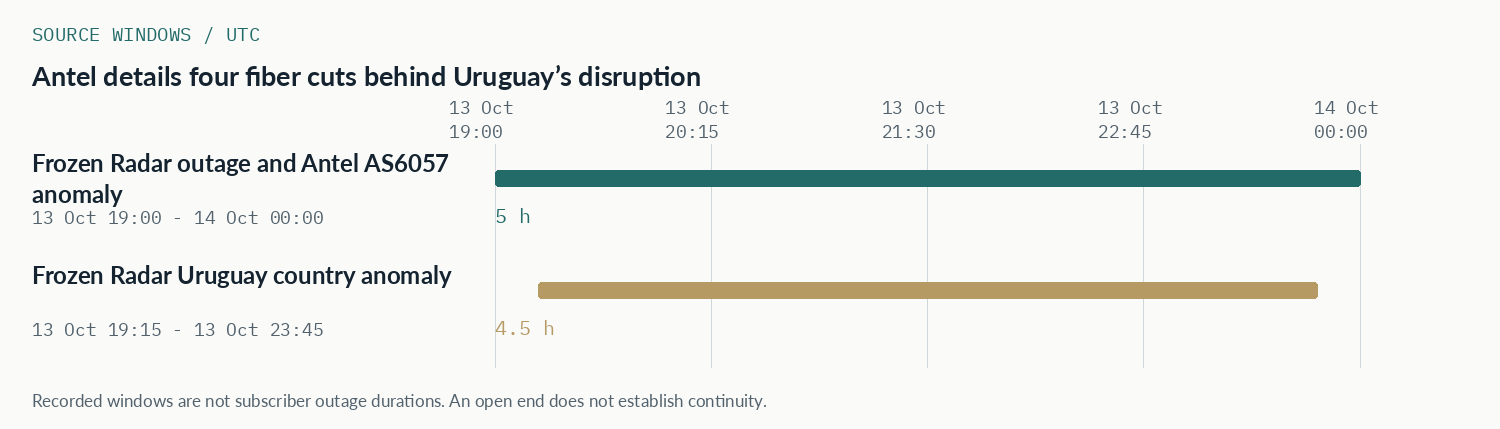
Antel details four fiber cuts behind Uruguay’s disruption
The frozen evidence packet contains a five-hour Radar record for Antel on October 13, accompanied by a slightly shorter Uruguay country anomaly. Radar described a near-total loss of Antel HTTP request traffic in eastern Uruguay and classified the incident as cable damage. The archived IODA check found no matching country alert, which does not negate a regional disruption. [1] [2]
Antel’s October 14 statement describes four backbone cuts associated with roadworks and construction. It identifies simultaneous cuts as the reason telecommunications were heavily affected in five eastern departments between “16:30 y las 19:00 h” on October 13. The statement does not specify a timezone. Antel’s incident account. [4]
The operator’s explanation supports grouping the outage and two anomalies into one story. Its repair and recovery stages should remain distinct from Radar’s traffic window. The available evidence does not establish how closely each restoration stage aligned with measured recovery, or which services remained impaired afterward. [1] [4]
What remains unresolved
- Antel gives no explicit timezone. Its October 13 cut and repair pairs are 09:10 to 15:25, 12:30 to 19:00, 14:35 to 02:40 on October 14, and 16:30 to 21:15. These are omitted from sourceWindows.
- Antel says connectivity problems began resolving after 21:15 and services were practically normal by midnight, with exceptions. These statements remain separate from Radar’s UTC endpoints.
- Which services and locations remained impaired after the Radar window ended?
- Antel’s statement was consulted through indexed publisher text; direct retrieval timed out.
- The IODA no-alert finding comes from the frozen evidence packet. The live dashboard did not expose historical measurements in the text browser.
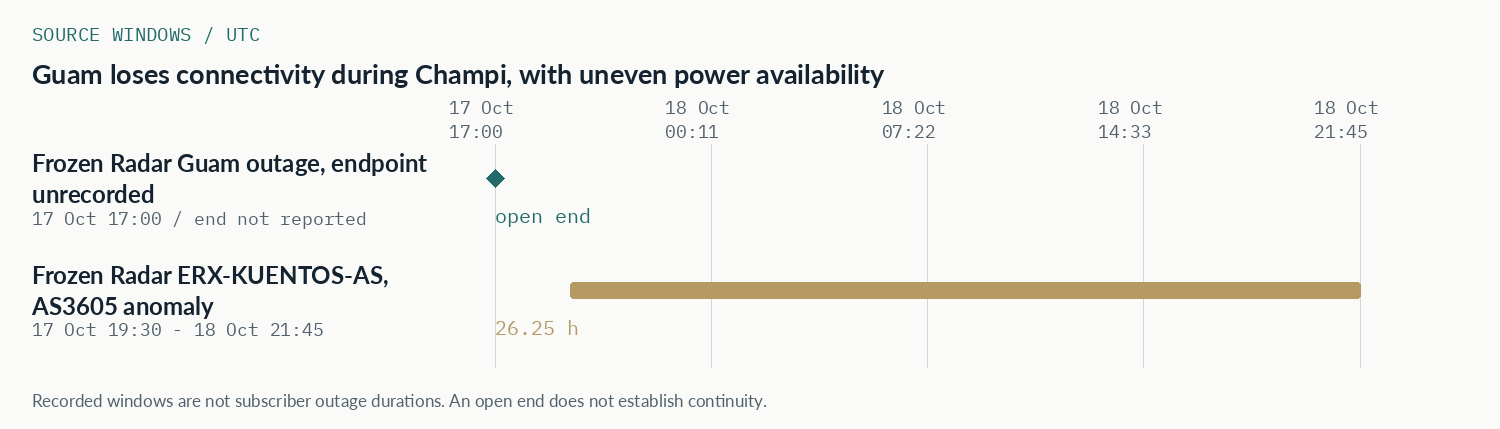
Guam loses connectivity during Champi, with uneven power availability
Radar’s Guam outage begins on October 17 and remains open in the frozen evidence packet. A separate anomaly on the ERX-KUENTOS network ends on October 18. The archived IODA check also detected a country-level active-probing disruption. That second monitor supports connectivity loss without establishing identical effects across the three networks Radar named. [1] [2]
Guam’s October 18 emergency bulletin documents uneven electricity availability following Champi. At its “9 a.m. today, October 18” update, approximately 51% of distribution feeders or circuits remained online. Officials explicitly said the grid had avoided a system-wide blackout and reported that most transmission lines supplying northern Guam remained intact. Government of Guam bulletin. [5]
The government account supports the storm context behind Radar’s natural-disaster classification, but it does not identify the failure mechanism at each telecommunications network. The closed network anomaly and open territory record also describe different scopes. Neither establishes uninterrupted island-wide loss of internet access through the archive’s collection time. [1] [5]
What remains unresolved
- Which connectivity losses resulted from electricity interruption, and which involved damaged telecommunications equipment or links?
- Radar names AS3605, AS395400 and AS9246. The archived country-level IODA signal does not independently establish impact on each network.
- The outage was still open at archive generation on 2026-10-19T13:00:21.821Z, outside the observation week. This is record status, not proof of continuous island-wide loss.
- The government bulletin says '9 a.m. today, October 18' without an explicit timezone. No precise government source window is encoded.
- The government bulletin was consulted through indexed publisher text; direct retrieval timed out.
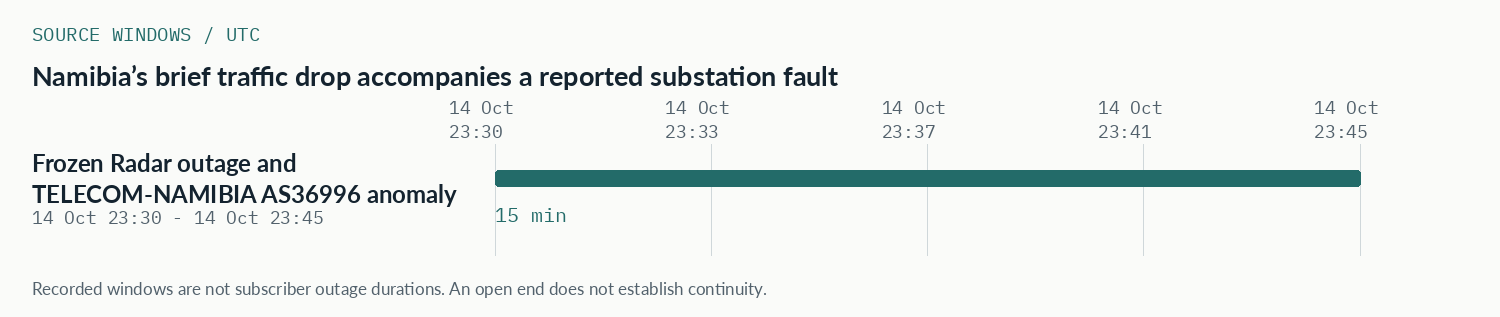
Namibia’s brief traffic drop accompanies a reported substation fault
Radar’s outage record and Telecom Namibia anomaly share a 15-minute window late on October 14 UTC. The frozen evidence packet also records a country-level IODA active-probing disruption. Although Radar labels the outage nationwide, its description identifies central, coastal and southern Namibia rather than establishing an interruption for every connection. [1] [2]
The Namibian’s October 15 report attributes the electricity interruption to a fault on the Kokerboom substation’s 400-kilovolt system, citing NamPower. It gives the power-loss interval as “01h31” to “01h49” on October 15, an 18-minute interruption. The article does not explicitly identify the timezone. The Namibian’s report. [6]
The reported utility explanation supports a power-related incident but does not document Telecom Namibia’s internal failure or recovery sequence. The electricity and traffic intervals should remain separate. Their differing lengths could reflect different monitored systems or recovery stages; the available evidence does not establish which explanation applies here. [1] [6]
What remains unresolved
- Did Telecom Namibia lose power at network facilities, or did disconnected customer equipment account for much of the observed traffic reduction?
- The reported October 15 electricity window, '01h31' to '01h49', lacks an explicit timezone and is omitted from sourceWindows.
- A directly accessible original NamPower incident statement was not located; the explanation rests on The Namibian’s reporting.
- IODA’s country-level signal does not establish AS36996-specific impact or a nationwide impact boundary.
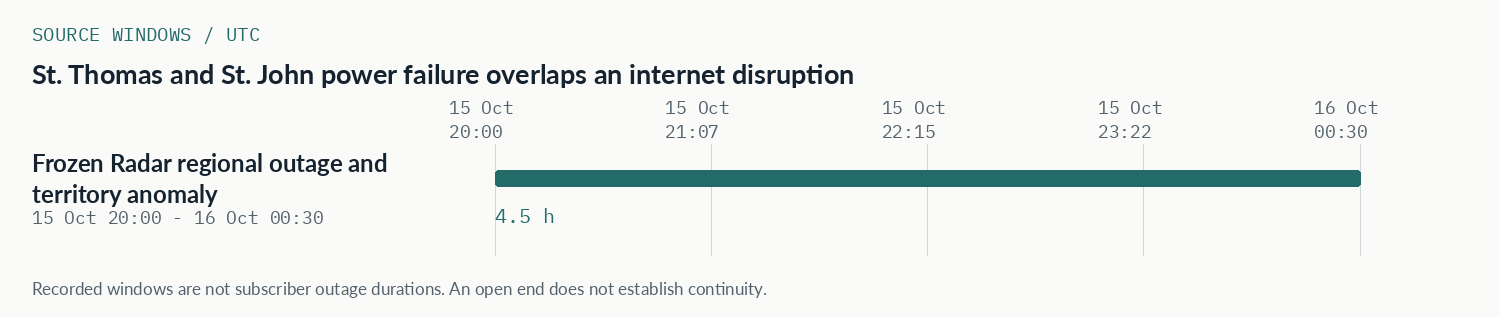
St. Thomas and St. John power failure overlaps an internet disruption
The frozen evidence packet’s Radar outage and U.S. Virgin Islands anomaly cover the same four-and-a-half-hour interval beginning October 15. Radar describes reduced traffic on St. Thomas and St. John and classifies the cause as power loss. IODA’s archived active-probing result supplies a second indication of connectivity disruption, but neither record identifies an affected telecommunications operator. [1] [2]
The Virgin Islands Consortium reported on October 16 that WAPA linked the districtwide electricity outage to lost generation at the Randolph Harley Power Plant. Restoration encountered further generation difficulties, and WAPA reported all affected feeders restored at “11 p.m.” on October 15. Earlier utility updates left the underlying cause unconfirmed. Consortium’s restoration report. [7]
The reporting supports an electricity-related explanation for the internet disruption while leaving the original generation failure unresolved. Power restoration progressed unevenly across feeders, so a single traffic endpoint cannot stand for every household’s recovery. The evidence concerns the St. Thomas and St. John district, without establishing a failure across all islands. [1] [7]
What remains unresolved
- What caused the initial generation loss, and which telecommunications facilities or customer areas lost connectivity?
- The Consortium gives October 15 updates at 7:43 p.m., 8:20 p.m. and 9:45 p.m., with full restoration at 11 p.m. It does not explicitly state a timezone, so these are omitted from sourceWindows.
- The utility restoration account and Radar’s endpoint are preserved separately; their relationship cannot be precisely reconciled from the cited report.
- The archived IODA result includes BGP evidence as well as active probing. These are signals from one measurement organization, not additional independent organizations.
- The original WAPA incident alerts were not retrieved; the utility explanation is cited through local reporting.
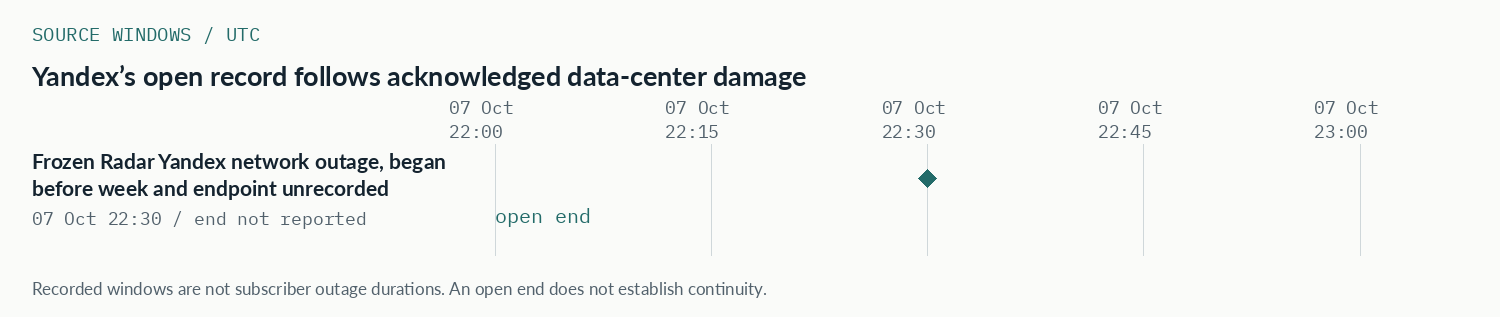
Yandex’s open record follows acknowledged data-center damage
The Yandex outage record begins on October 7 and remains open in the frozen evidence packet. Radar names Yandex and YandexCloud networks and classifies the incident as military action. The accompanying IODA result concerns Russia at country level, so it cannot independently establish either company’s service availability throughout the record’s open interval. [1] [2]
In an October 9 statement, Yandex said a drone attack had seriously damaged its Sasovo facility overnight on October 7 to 8, forcing a complete shutdown. It also reported partial infrastructure loss at Kaluga after another attack that morning. Restoration timing remained uncertain. This statement predates the observation week. Yandex’s original statement. [8]
Reuters reported on October 11 that Yandex acknowledged damage and a complete shutdown at its Vladimir-region data center, leaving some services unavailable. That report also predates the observation week and relays the operator’s account. It adds another facility to the reported damage without providing a service-by-service recovery timeline. Reuters. [9]
Le Monde’s October 13 report described problems with email, taxis and meal deliveries, alongside partial recovery. It reported Yandex’s statement that disruptions to most web services had been resolved, while Yandex Cloud remained restricted as of October 12. Those dated claims show why an open network record cannot establish continuous unavailability across every product. Le Monde. [10]
The operator acknowledgments provide evidence of physical damage beyond Radar’s classification. The open measurement record still cannot serve as a continuous outage clock for all Russian users or Yandex services. The reported recovery is meaningful, but determining what remained impaired during the week requires more complete, dated service-level information. [1] [8] [9] [10]
What remains unresolved
- Which Yandex services and facilities remained impaired during October 12 to 18, and when did each recover?
- AS13238 and AS200350 are named in Radar. Russia-level IODA evidence does not independently verify either ASN’s impact.
- The record remained open at archive generation on 2026-10-19T13:00:21.821Z. This does not demonstrate 278 hours of continuous nationwide internet loss.
- Yandex’s October 9 statement and Reuters’ October 11 report are pre-week context. They describe separate facilities and dates, not one precisely timed outage window.
- Reuters and Le Monde relay Yandex statements. Their repetition does not create independent evidence lineages for those operator claims.
- Le Monde’s October 13 recovery reporting and its October 12 Cloud status are date-level context, not precise restoration windows.
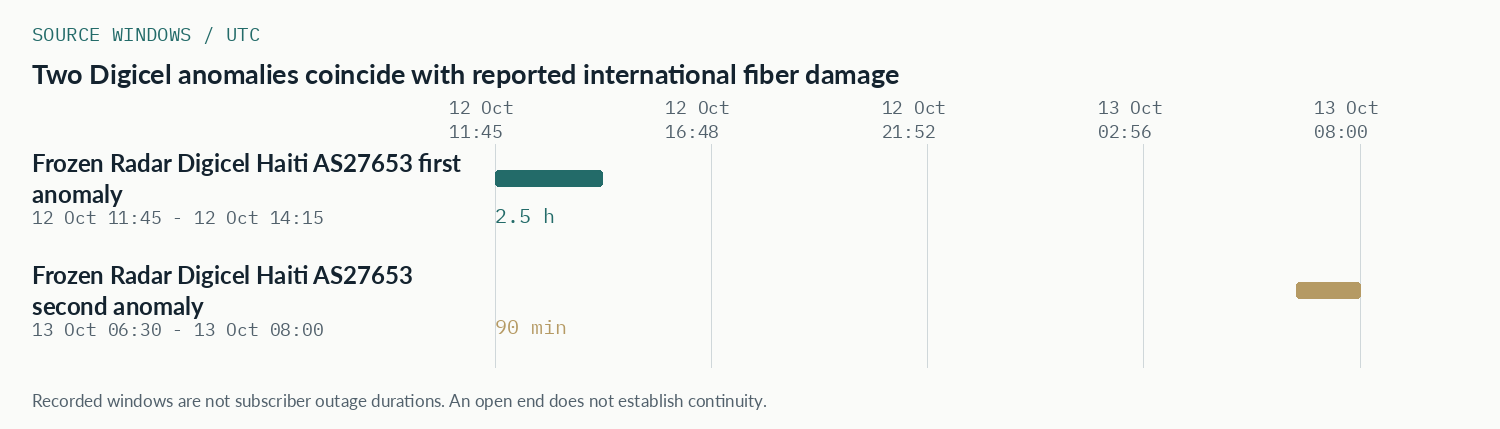
Two Digicel anomalies coincide with reported international fiber damage
Radar records in the frozen evidence packet flag two separate Digicel Haiti anomalies, lasting two and a half hours on October 12 and one and a half hours on October 13. Both concern the same network and include HTTP and network traffic signals. The gap between them is preserved; the archive does not establish one uninterrupted outage spanning both days. [1]
Gazette Haiti reported on October 13 that Digicel’s previous-day notice identified damage to two international fiber links along Route Nationale 1, disrupting several services. The report says Digicel considered nearby gunfire a possible explanation, while the exact cause remained unconfirmed. It supplied no precise full-restoration deadline. Gazette Haiti’s account of the notice. [11]
The dated operator account provides relevant context for the two network signals, but it does not map the individual anomalies to repair stages or separate faults. Fiber damage is reported; the mechanism that damaged the cables remains unverified. A repair chronology would help determine whether both measured episodes belonged to the same incident. [1] [11]
What remains unresolved
- Did both AS27653 anomalies result from the two damaged international links, or did another fault produce one of the episodes?
- The original Digicel notice was not retrieved directly. Gazette Haiti and other reports repeating it represent the same operator-statement lineage.
- The reported October 12 notice is date-only context and supplies no precise event window.
- No responsible actor or intentional targeting of the cables is established by the cited evidence.
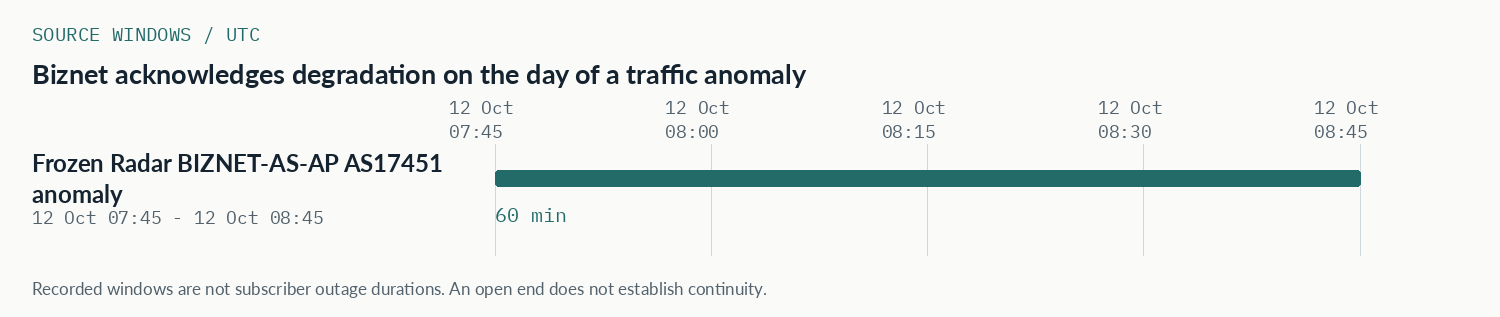
Biznet acknowledges degradation on the day of a traffic anomaly
The frozen evidence packet contains a one-hour Radar anomaly for Biznet on October 12, using both HTTP and network traffic signals. The record identifies an Indonesian-registered network but gives no measured geographic boundary or customer count. It supports a network traffic disturbance without establishing that all Biznet customers, or Indonesia generally, lost access. [1]
Biznet’s October 12 notice is headed as international-link performance degradation. It acknowledges reduced internet service quality, says technicians are working on repairs and asks customers to keep their equipment or modems powered. The notice supplies no precise onset, restoration time or incident-specific geographic list. Biznet’s customer notice. [12]
The operator notice strengthens the case that customers experienced a service problem that day. Its date alone cannot prove that the entire notice describes Radar’s one-hour interval. The underlying technical fault, the geographic extent of customer impact and the relationship between repairs and measured traffic recovery remain unresolved. [1] [12]
What remains unresolved
- What failed on the international connection, and did the repair interval match the AS17451 anomaly?
- Biznet’s notice is dated October 12 without precise event times; it is context rather than an encoded source window.
- The notice does not establish an incident-specific geographic boundary. A general city directory must not be treated as an affected-area list.
- The original Biznet Home URL returned 404 during correction. The equivalent dated notice was consulted through indexed text on Biznet Networks; direct retrieval of that page also failed.
Overlapping Iraqi traffic signals remain unexplained
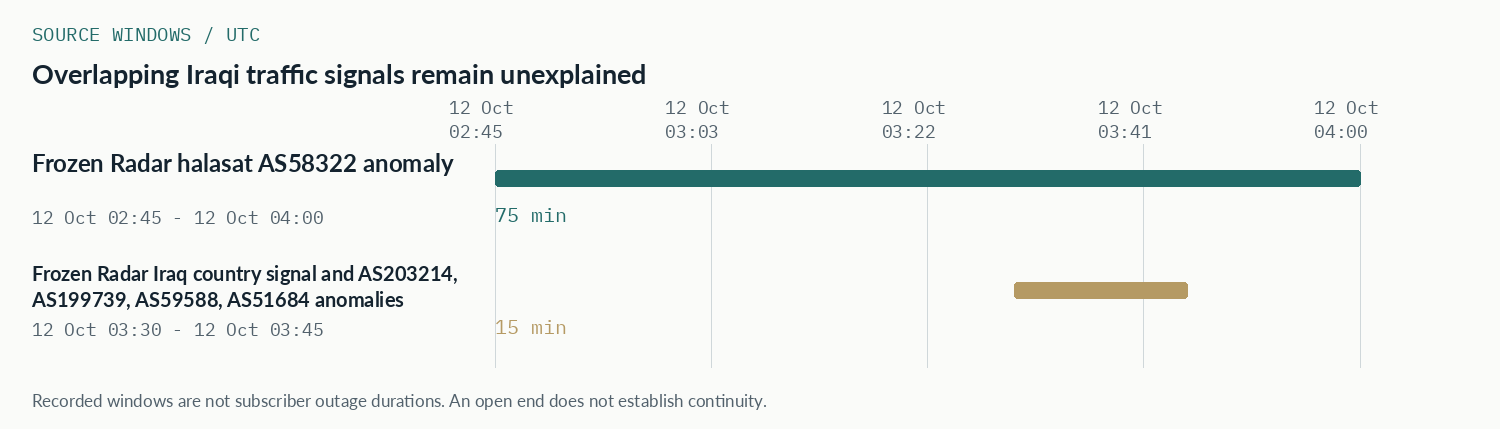
Six Radar anomalies in the frozen evidence packet overlap on October 12. The Iraq country signal and records for HulumTele, Earthlink-DMCC-IQ, ZAINAS-IQ and Asiacell share a 15-minute interval; halasat’s longer anomaly surrounds it. Their timing makes them a coherent investigation lead. Earthlink’s United Arab Emirates registration does not establish a separate outage affecting users there. [1]
Targeted searches did not locate an operator or government explanation matching this October 12 interval. The synchronized records suggest a shared disturbance worth investigating, but the cause remains unverified. Timing alone does not establish an ordered shutdown, an examination-related restriction or a common infrastructure failure across the named networks. [1]
What remains unresolved
- Did a shared upstream event affect these networks, and can an operator provide a matching incident notice?
- The networks are AS58322, AS203214, AS199739, AS59588 and AS51684. Registration countries are not measured impact locations.
- No event-specific independent measurement result is supplied for this anomaly group in the frozen evidence packet.
- Earlier examination-shutdown documentation does not establish the cause of these October 12 signals.
Three Republic of the Congo anomalies lack a verified cause
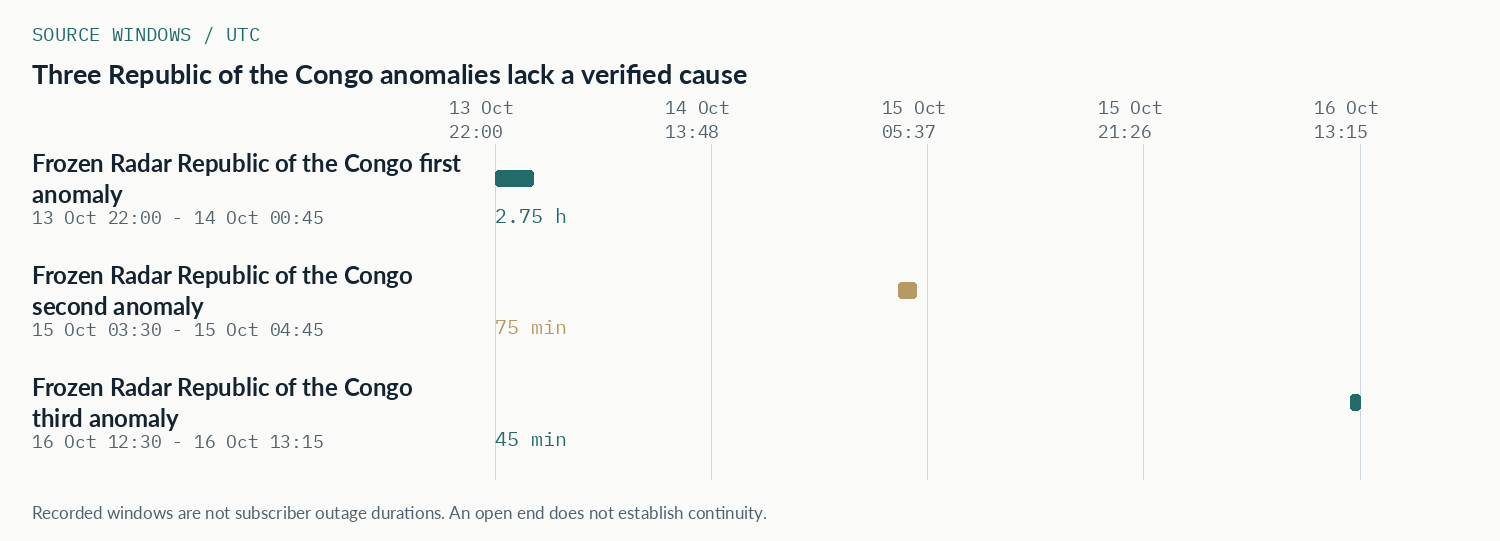
Radar records in the frozen evidence packet identify three distinct country anomalies in the Republic of the Congo: one beginning October 13 and two on October 15 and 16. Their recorded spans are two hours and 45 minutes, 75 minutes and 45 minutes. No operator is named, and the separate episodes do not establish continuous nationwide loss between them. [1]
Targeted searches did not identify a matching operator explanation or event-specific original report for these windows. The repetition warrants follow-up, but it supplies no verified cause or common failure mechanism. These records concern the Republic of the Congo; reporting about the neighboring Democratic Republic of the Congo cannot explain their geographic scope. [1]
What remains unresolved
- Which networks and locations contributed to each country-level signal, and did the episodes share a cause?
- CG denotes the Republic of the Congo. CD denotes the Democratic Republic of the Congo and is outside this story’s measured scope.
- The frozen evidence packet supplies no matching IODA check for these anomalies and no quantified impact boundary.
Six other network signals remain separate, unexplained leads
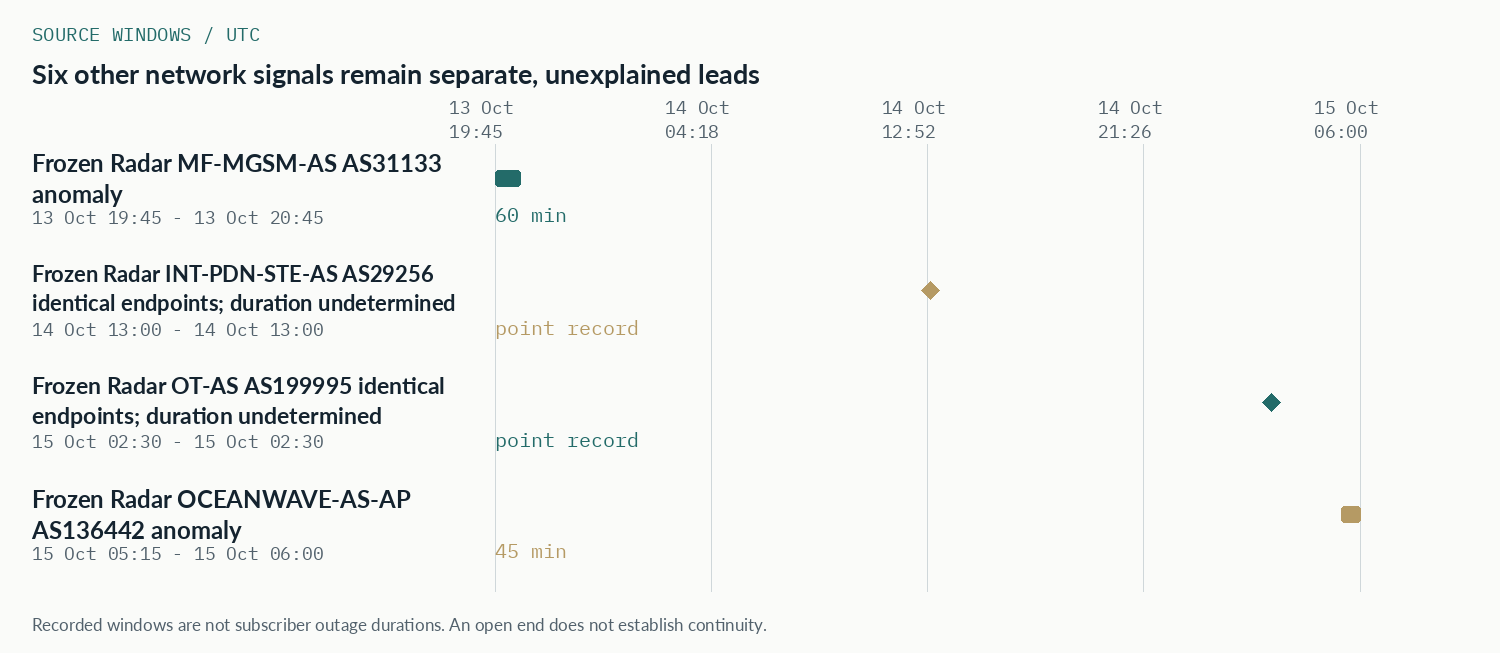
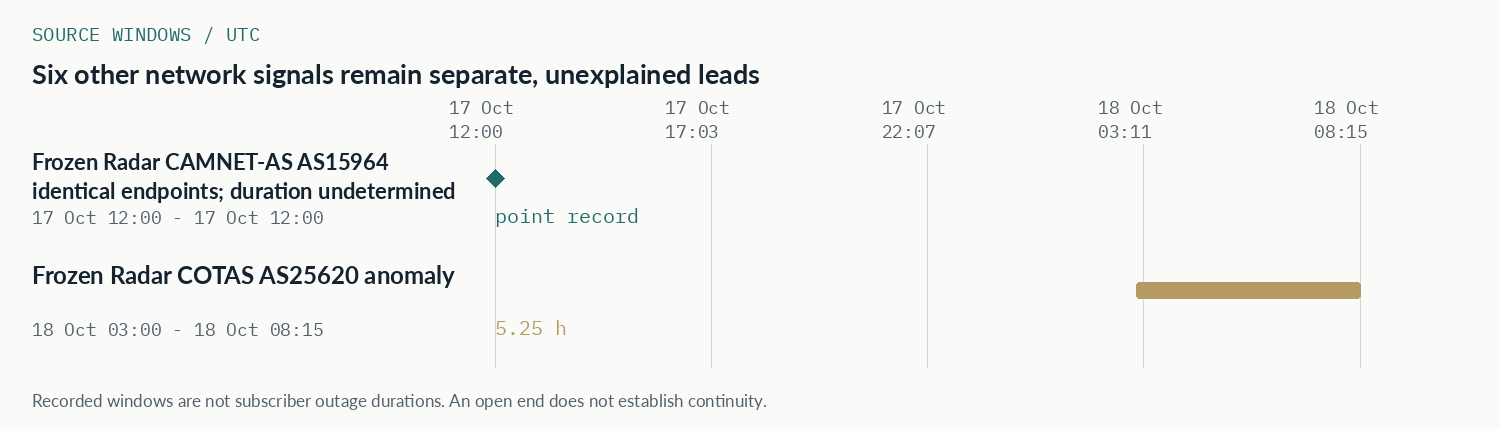
Three additional Radar network anomalies in the frozen evidence packet have bounded intervals: MF-MGSM in Russia for one hour on October 13, Oceanwave in Myanmar for 45 minutes on October 15, and COTAS in Bolivia for five hours and 15 minutes on October 18. They are separate leads, with no evidence here of a shared cause or a connection to the Yandex incident. [1]
Records for Syria’s INT-PDN-STE, Ukraine’s OT-AS and Cameroon’s CAMNET each contain identical start and end timestamps. Those entries identify moments flagged by the archive but do not establish zero-minute outages or usable durations. The OT-AS entry also lacks a meaningful data-source label, leaving less information about what triggered its detection. [1]
Searches by network, country and event date did not locate explanations that could be securely matched to these six records. They remain cause-unconfirmed leads, without established customer impact. Operator incident timelines or independent measurements at the same network and time would be needed to turn them into fuller outage accounts. [1]
What remains unresolved
- What caused each of the MF-MGSM AS31133, Oceanwave AS136442 and COTAS AS25620 anomalies, and which services were affected?
- What durations and underlying samples belong to the INT-PDN-STE AS29256, OT-AS AS199995 and CAMNET AS15964 records with identical endpoints?
- OT-AS contains an empty dataSources value. Its measurement method cannot be recovered from this archive.
- Same-day Russian subscriber-complaint reporting did not match the archived evening interval sufficiently to establish the AS31133 event’s cause.
- A Syria report found in research described a different overnight window. It was not treated as an explanation of the 13:00 UTC record.
- Network registration countries do not establish geographic impact boundaries. No event-specific IODA matches are supplied for these six anomalies.
Sources and evidence
1. Cloudflare: Cloudflare Radar Outage Center. Supports: Evidence origin for the Radar records in the user-supplied frozen evidence packet, including UTC windows, network identifiers, descriptions and provider classifications. The consulted landing page confirms UTC display and automated anomaly detection but does not independently prove the historical records. Those records were checked against the supplied packet, not re-extracted from the live dashboard. [1]
2. Georgia Tech Internet Intelligence Lab: IODA Internet Outage Detection and Analysis. Supports: Evidence origin for the IODA findings in the user-supplied frozen evidence packet: country-level active-probing disruptions in Guam, Namibia, the U.S. Virgin Islands and Russia, plus no matching Uruguay alert. The consulted dashboard returned an application shell and did not independently reproduce these historical findings. Exact alert endpoints were not supplied. [2]
3. CAIDA: IODA measurement methods and project history. Supports: Primary project documentation explaining active probing, BGP and passive measurement, and the distinction between country and network scope. Documents IODA’s move to Georgia Tech. Methodological context only; it does not verify the week’s events. [3]
4. Antel: Antel report on national backbone fiber cuts (2026-10-14). Supports: Original operator explanation and separate impact, repair and recovery times. Consulted through indexed publisher text after direct retrieval timed out. [4]
5. Guam Homeland Security and Office of Civil Defense: Guam emergency bulletin 14: storm and power-system update (2026-10-18). Supports: Official storm-related power status, circuits remaining online and explicit statement that the grid avoided a system-wide blackout. Consulted through indexed publisher text after direct retrieval timed out. [5]
6. The Namibian: NamPower explains Kokerboom fault and restoration (2026-10-15). Supports: Reporting of NamPower’s statement on the fault, affected regions and 18-minute electricity interruption. [6]
7. The Virgin Islands Consortium: St. Thomas and St. John power outage and restoration (2026-10-16). Supports: WAPA’s reported generation loss, staged restoration, further difficulties and final restoration announcement. [7]
8. Yandex: Yandex statement on Sasovo and Kaluga data-center damage (2026-10-09). Supports: Original operator acknowledgment of drone damage, facility shutdown and uncertain restoration timing; pre-week context. [8]
9. Reuters, republished by Business Recorder: Yandex acknowledges Vladimir data-center shutdown (2026-10-11). Supports: Reporting of Yandex’s acknowledgment of Vladimir damage and unavailable services; pre-week context within the operator-statement lineage. [9]
10. Le Monde: Service disruption and partial recovery after Yandex data-center attacks (2026-10-13). Supports: In-week reporting of service problems, Yandex’s recovery claims and restricted Cloud operation as of October 12. Does not establish continuous unavailability across all services. [10]
11. Gazette Haiti: Digicel reports damage to two international fiber links (2026-10-13). Supports: Reporting of Digicel’s October 12 notice, damaged links, service disruption and unconfirmed damage mechanism. [11]
12. Biznet Networks: Biznet international-link performance degradation notice (2026-10-12). Supports: Original customer notice acknowledging degraded service and repair work. Consulted through indexed operator-page text; direct retrieval failed. Provides no precise incident times or incident-specific geographic list. [12]
Method and reporting window
This issue covers records overlapping 2026-10-12T00:00:00.000Z through 2026-10-19T00:00:00.000Z, with the end excluded. The evidence snapshot was assembled at 2026-10-19T13:00:21.821Z. Continuing events can appear in adjacent issues.
Signal Atlas compares public measurements; it does not operate its own probes. IODA country-level connectivity checks use a three-hour margin around the relevant record window. Multiple IODA sensors are one organisation. News reporting can supply context without becoming another independent internet measurement. Traffic anomalies can overlap outage reports and must not be added as separate confirmed incidents.