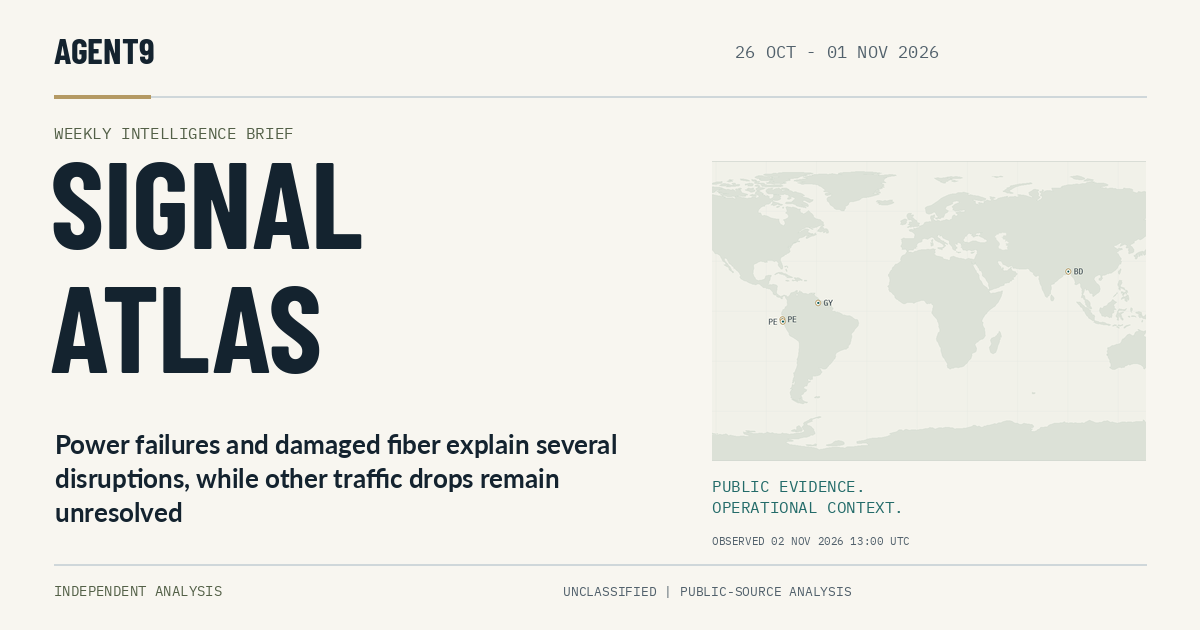
Archived measurements for October 26 through November 1 show four reported outages alongside overlapping and unexplained traffic anomalies. Reporting connects Digicel Haiti’s interruption to damaged fiber links and documents electricity failures in Guyana, Bangladesh and northern Peru. Those accounts do not establish identical electricity and internet recovery times. Guyana has a second measurement source supporting connectivity loss, while Mexican customer reports add context to simultaneous provider anomalies. Several other signals remain unexplained, and VK’s open record does not establish continuous loss of service. [1] [5] [6] [3] [8] [12] [14]
Haiti’s longest reported interruption has a documented repair obstacle. Radar records a 22-hour-15-minute Digicel Haiti disruption. Reporting quotes the operator describing damaged international fiber links and difficulty reaching repair sites. Its account supports a physical infrastructure explanation, without independently establishing responsibility for the damage. [1] [5] [6]
Electricity and internet recovery follow different clocks. Reports document power failures in Guyana, Bangladesh and northern Peru, but their times do not exactly match Radar’s traffic windows. Grid reconnection, customer electricity restoration and internet recovery should remain separate milestones. [1] [3] [8] [12]
Simultaneous Mexican signals have no established shared cause. Izzi and Totalplay anomalies begin together in the archive. Mexican reporting also describes customer connection problems, but neither matching timestamps nor overlapping complaints establish a common technical failure. [1] [14]
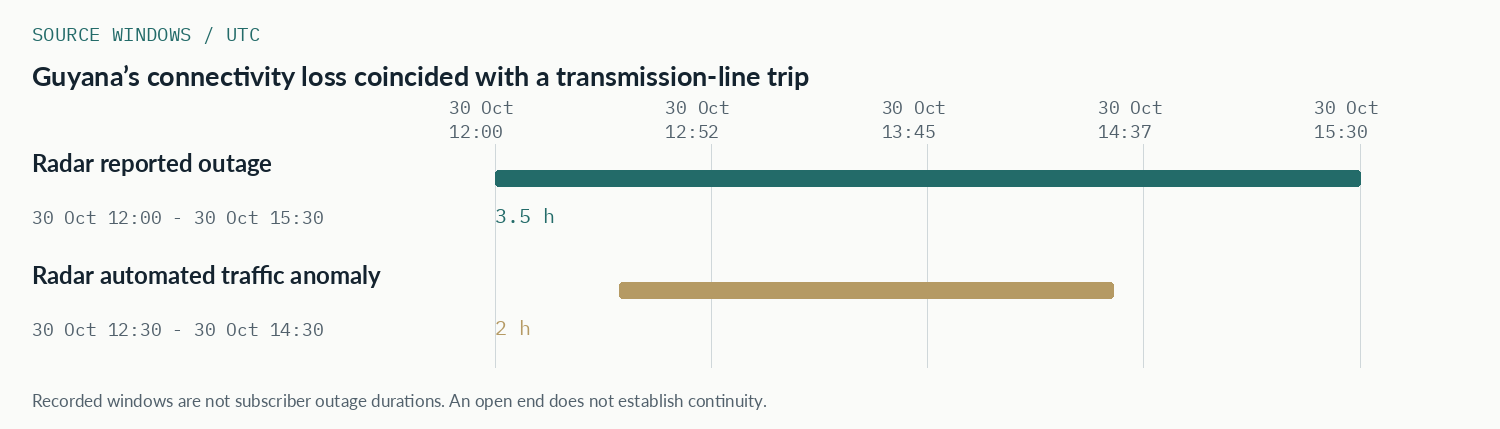
Guyana’s connectivity loss coincided with a transmission-line trip
Cloudflare’s archived outage record covers three and a half hours on October 30. Its separate automated anomaly covers a shorter, overlapping two-hour period. The archived IODA check also detected lost connectivity through active probing, providing a second monitor’s evidence of disruption. Neither country-level signal establishes that every community or internet provider lost service. [1] [2]
In its October 30 statement, reproduced by Guyana Standard, Guyana Power and Light said the line between Grove and Sophia tripped at approximately “08:12 hrs.” The utility reported an earth fault and said subsequent inspections found no physical explanation. It suspected deliberate interference, but the statement supplied no independently verified evidence establishing sabotage or identifying an actor. [3]
La Caribeña News preserved a ministry-published utility notice reported at “9.51am Guyana time” on October 30. It listed Georgetown, East Coast and East Bank Demerara, West Demerara and Berbice, with restoration time unknown. That notice time, the utility’s earlier trip time and Radar’s traffic window describe different milestones and should not be substituted for one another. [4] [3] [1]
The evidence supports a connectivity disruption associated with a documented electricity failure. Radar’s nationwide classification is broader than the geographic detail in the utility reporting, which concentrates on Demerara and Berbice. The remaining questions are which internet networks lost service, when electricity returned across affected areas, and whether a completed investigation explains the line trip. [1] [2] [3] [4]
What remains unresolved
- Which internet providers and communities were affected, and did their recovery times differ?
- Radar classifies outage:1741 as NATIONWIDE and POWER_OUTAGE. These are provider classifications, not verified impact boundaries or findings about the initiating fault.
- The archived IODA result establishes active-probing disruption somewhere within Radar's window; it supplies no exact independent start or end, so no IODA source window is invented.
- GPL's October 30 statement gives approximately '08:12 hrs' without an explicit timezone in the consulted reproduction. No sourceWindows entry is assigned to it.
- The ministry notice was reported at '30 October 2026, 9.51am Guyana time'; this is a notice timestamp, not a verified outage onset. It gave no restoration time.
- The archived Radar outage begins at 12:00 UTC, while its anomaly begins at 12:30 UTC and ends an hour earlier. Both windows are retained.
- GPL's allegation of deliberate interference remains unverified. Reproductions of its statement constitute one explanation lineage.
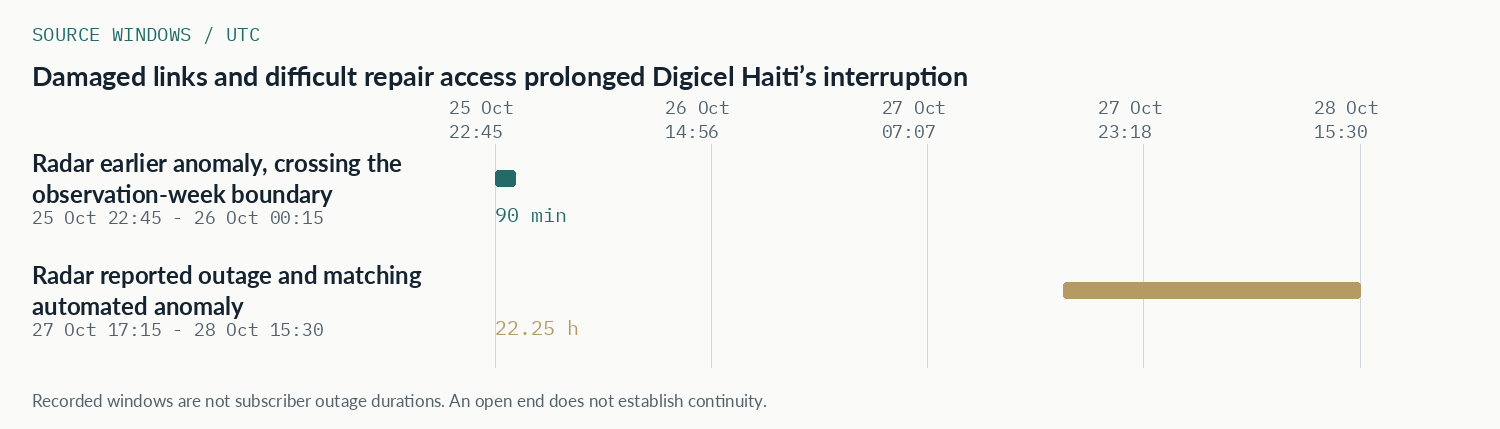
Damaged links and difficult repair access prolonged Digicel Haiti’s interruption
Radar’s archived Digicel Haiti outage spans 22 hours and 15 minutes across October 27 and 28. An automated anomaly has exactly the same endpoints, so these are two records of one episode. A separate 90-minute anomaly began on October 25 and extended into the observation week; its relationship to the longer interruption is unestablished. [1]
Kominotek’s October 28 report quotes chief executive Jean-Philippe Brun describing two damaged international fiber links along Route Nationale 1. According to that account, technicians had located the damage on October 27, but insecurity impeded access. The following day, teams believed they could reach the sites after evaluating routes; no firm restoration estimate was available before inspection. [5]
An October 30 RL News Haiti report relayed Digicel’s account that a link was damaged on October 27 “vers 13 h” and service returned Wednesday. The operator attributed that damage to tree cutting for barricades and said another link had already been cut the previous week. It acknowledged difficulties communicating, working and accessing financial services. [6]
The reporting supports damaged fiber and constrained repair access as the operator’s explanation for the long interruption. It does not independently establish who damaged the links or connect the earlier anomaly to the same incident. The key operational gap is whether Wednesday’s restoration covered every affected service, including financial transactions, or whether some customers recovered later. [1] [5] [6]
What remains unresolved
- Did all affected Digicel services recover together, and what explains the October 25 to 26 anomaly?
- The network is AS27653. Haiti is its registration-country reference, not a measured nationwide impact boundary.
- Radar describes a complete network outage and classifies the cause as CABLE_CUT; those descriptions remain attributed to Radar.
- The October 30 report gives damage timing as October 27 'vers 13 h' without an explicit timezone and restoration only as Wednesday. Neither becomes a precise source window.
- The two damaged links need not have been damaged simultaneously: the October 30 account says one had already been cut the previous week.
- The archived independent check was unavailable because the outage record lacked a country reference. This does not mean independent network-level investigation is impossible.
- The cause and repair accounts originate with Digicel. Multiple articles relaying those statements are not independent confirmation of responsibility.
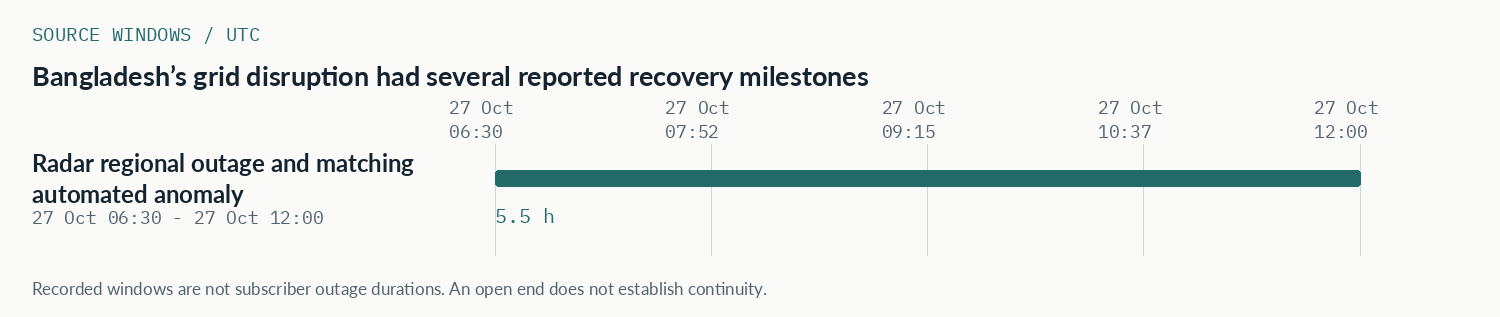
Bangladesh’s grid disruption had several reported recovery milestones
Radar’s reported outage and automated Bangladesh anomaly share a five-and-a-half-hour window on October 27. Radar classifies the event as regional and power-related, naming eastern Dhaka and parts of Chattogram. The archived IODA check found no matching alert. That absence leaves the internet disruption without a second measurement confirmation here, but does not disprove a regional event. [1] [2]
Bangladesh Sangbad Sangstha reported that the electricity board chairman attributed the interruption to a trip on the Meghnaghat-Haripur line. Its account described about an hour of disruption affecting the Secretariat, surrounding areas and parts of Chattogram. This provides a named official’s explanation of the electricity failure, rather than independent proof of the duration of internet loss. [7]
Dhaka Stream’s October 27 restoration report gives an electricity interruption beginning at “12:43pm” and grid restoration completed at “2:30pm.” It also says generators were returning in phases and distribution loads were rising gradually. Separately, bdnews24 described a six-hour outage, while The Business Standard quoted an electricity official expecting conditions to improve around “10pm.” [8] [9] [10]
These accounts should remain separate: restoring transmission lines does not establish that generation, household electricity and internet access recovered simultaneously. The reporting supports a grid disturbance but leaves the detailed failure mechanism under investigation. Which restoration milestone best explains Radar’s longer traffic reduction, and which districts remained affected after grid reconnection, are still unresolved. [1] [8] [9] [10]
What remains unresolved
- Which affected districts and internet providers explain the full five-and-a-half-hour traffic window?
- The reported '12:43pm' onset and '2:30pm' grid restoration on October 27 lack explicit timezones in the consulted Dhaka Stream text. They are preserved as written and omitted from sourceWindows.
- BSS describes about an hour of interruption; bdnews24 describes a six-hour outage. These reports may describe different places or restoration stages, which the consulted evidence does not reconcile.
- The Business Standard's October 27 report quotes expected improvement around '10pm'. This was a forecast, not a confirmed restoration endpoint, and its timezone is not explicit.
- A consulted secondary timeline, Your Power Setup, additionally reports conflicting '13:40' and '14:30 local' transmission restoration times. The earlier time was not verified in an original statement and is not adopted.
- Radar's power-outage classification and official descriptions of a line trip do not establish the underlying technical cause.
- The IODA absence applies to the archived country-level alert check, not every possible sensor or affected network.
Northern Peru’s power failure overlaps a regional internet disruption
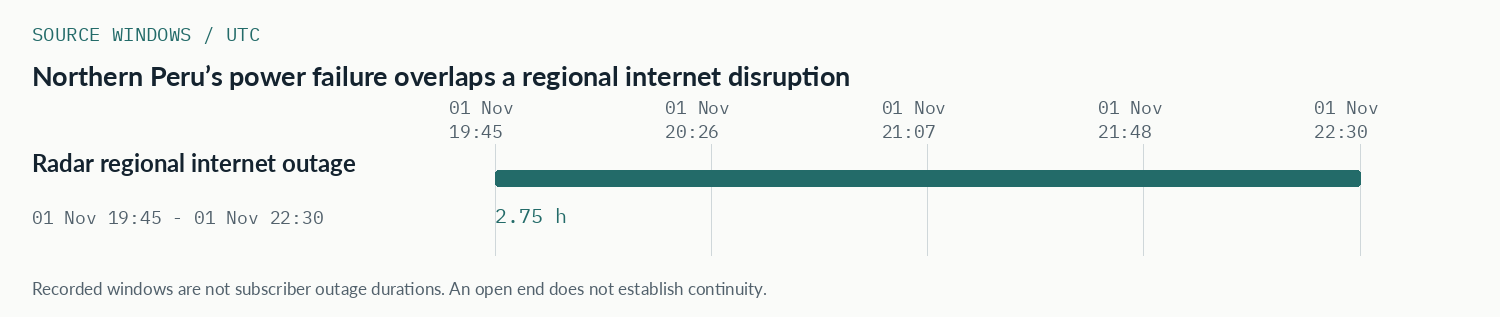
Radar’s archived November 1 record describes a regional internet disruption lasting two hours and 45 minutes, with Piura and Lambayeque as geographic references. Its narrative places the Piura traffic decline around 14:45 local time. No affected internet provider is named, and the archived IODA country check contains no matching alert. [1] [2]
Infobae’s November 1 report relays Enosa’s account of a national interconnected electricity-system event that disconnected the Trujillo Norte-REP and Guadalupe transmission lines. It gives the power interruption’s start as “15:03 horas,” covering localities across northern Peru. Enosa was coordinating with the system operator and had not supplied a complete restoration deadline or detailed initiating cause. [12]
The reported electricity interruption is relevant context for Radar’s power classification, but its stated onset differs from Radar’s local-time narrative. The electricity footprint also extends beyond the regions in the internet record. Establishing the relationship requires a reconciled timeline and provider-level evidence; the consulted reporting does not justify attributing the failure to weather or treating all northern residents as disconnected. [1] [12]
What remains unresolved
- Why does Radar describe a decline around 14:45 local while electricity reporting gives '15:03 horas'?
- Infobae's November 1 power-onset time has no explicit timezone in the consulted text, so it is not converted into a sourceWindows entry.
- Radar supplies an explicit 19:45 UTC start and a 22:30 UTC end; these are traffic-record endpoints, not verified electricity restoration times.
- Which networks and localities in Piura and Lambayeque lost connectivity?
- The consulted Correo November 1 archive separately identifies disconnection of the L-5008 Nueva Chimbote-Trujillo line and gives '3:03 p. m.' as the power onset. The relationship between that line and Enosa's named downstream disconnections remains unresolved.
- Enosa's explanation was accessed through reporting; its government portal could not be retrieved. The source does not attribute the outage to rain.
- The lack of an archived IODA country alert does not rule out regional internet loss.
Izzi and Totalplay signals align with customer complaints
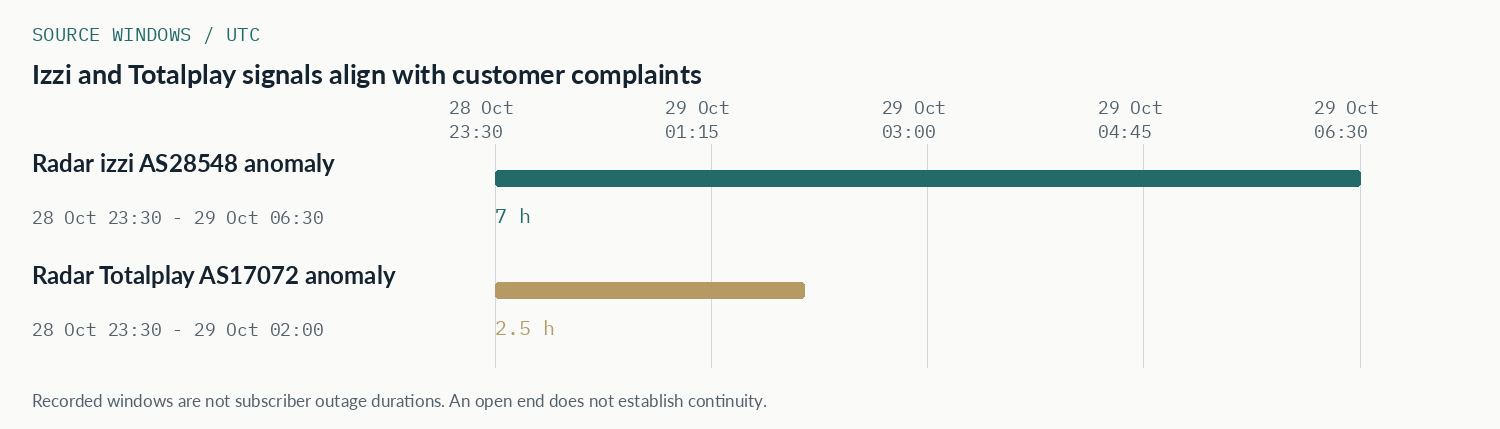
The archived izzi and Totalplay anomalies begin at the same time on October 28, but end at different times the following day. Izzi’s record spans seven hours and Totalplay’s two and a half hours. These are provider-network traffic anomalies, with no cause recorded; their Mexican registration references do not establish nationwide service loss. [1]
Ejecentral’s October 28 reporting describes connection complaints involving both providers and says Totalplay acknowledged problems in certain areas. Much of the geographic detail comes from Downdetector reports, which reflect participating customers rather than a complete service census. The article supplies no confirmed common cause, complete list of affected locations or final restoration time. [14]
The matching starts and same-day complaints justify discussing these records together, while leaving their causes unresolved. They do not establish that both providers experienced the same upstream failure. The useful next evidence would be an operator incident account identifying the affected infrastructure and distinguishing access-network problems from difficulties reaching particular online services. [1] [14]
What remains unresolved
- Did izzi and Totalplay share a failed dependency, or were the interruptions separate?
- The archived networks are izzi AS28548 and Totalplay AS17072. Both records carry the provider verification label TP; that label does not establish a cause.
- Ejecentral is dated October 28 and displays '20:05' without an explicit timezone. It provides no precise service-loss window, so no corresponding sourceWindows entry is created.
- Totalplay's acknowledgment was accessed through reporting, not a directly retrievable incident statement.
- Reports drawing on the same Downdetector complaints are one complaint-data lineage, not multiple independent measurements.
- No evidence consulted establishes a nationwide outage or a shared Cloudflare failure.
VK’s open anomaly leaves the duration of service impact unresolved
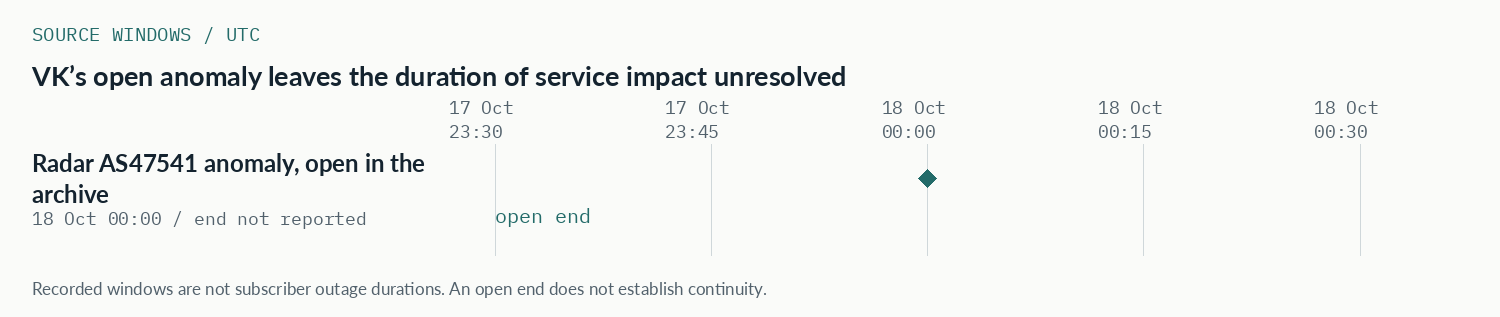
The VK network anomaly began on October 18 and still has no end timestamp in the archived measurements. That makes it a carryover record, rather than a newly observed outage this week. An open traffic anomaly cannot establish uninterrupted loss of access, and the network’s Russian registration does not define where users experienced problems. [1]
As context predating this week, Fontanka reported on October 18 that VK acknowledged a drone attack on its data center in the Leningrad region while saying services remained normally available. The report also noted earlier user access complaints. That tension is relevant to the anomaly’s starting date, but does not establish how the network behaved throughout the following week. [15]
The unresolved issue is whether the continuing record reflects persistent traffic displacement, intermittent service degradation or an anomaly that had not been closed. The available material cannot choose among those possibilities. A dated network explanation and service recovery evidence would be needed before assigning the entire open interval to the reported October 18 incident. [1] [15]
What remains unresolved
- What explains the still-open AS47541 record, and when did any customer-facing impact end?
- The start predates the observation week by eight days. A null end is not proof of continuous disruption through November 1.
- Fontanka's October 18 report links VK's original statement, but that operator page could not be retrieved. The company account is therefore attributed through Fontanka.
- The report displays '18 October 2026, 05:37' without an explicit timezone in the consulted article text; it is not used as an event window.
- Neither the anomaly nor the cited statement establishes a cyberattack, nationwide internet loss, or responsibility for the reported physical attack.
Camtel has overlapping published signals, but no verified cause
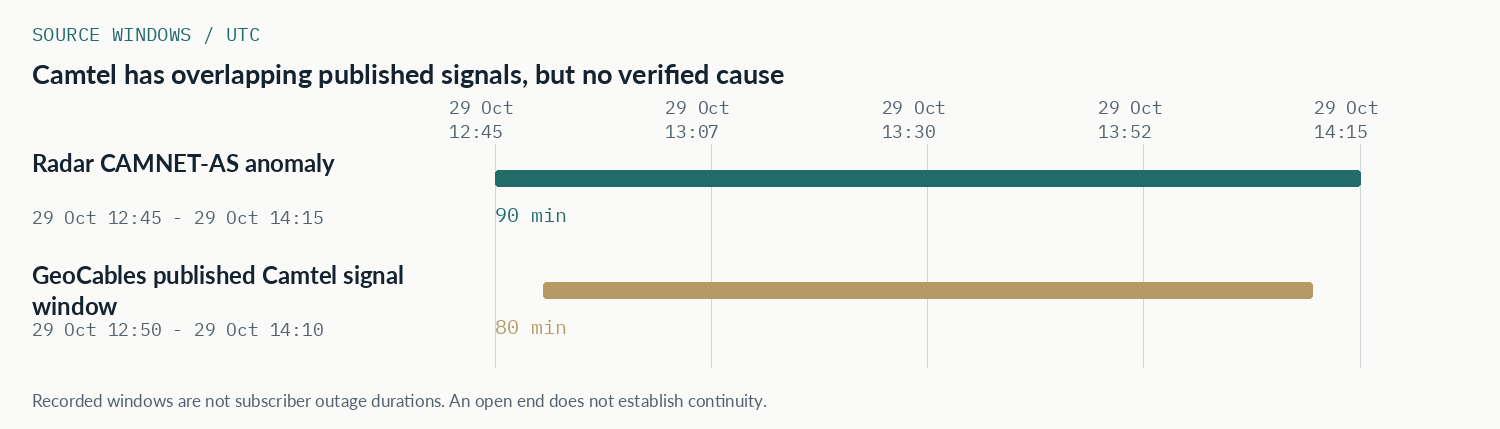
Radar’s archived CAMNET-AS anomaly spans 90 minutes on October 29. A separate GeoCables page reports a Camtel signal reduction over an overlapping 80-minute period. The two published windows are close but not identical. GeoCables supplies additional measurement context, while neither record identifies the underlying fault or establishes how many customers lost service. [1] [16]
No event-specific Camtel explanation was located in the consulted public sources. GeoCables describes its cause suggestions as heuristic, so they are not adopted as a diagnosis. This remains a cause-unconfirmed lead: which services and locations were affected, and whether the change resulted from an access, routing or other operational problem, still require an operator account. [1] [16]
What remains unresolved
- Which Camtel services and locations were affected, and what caused the October 29 change?
- The archived network is AS15964. Cameroon is the network-registration reference, not an impact boundary.
- GeoCables reports 12:50 to 14:10 UTC, compared with Radar's 12:45 to 14:15 UTC. Both are retained.
- GeoCables discusses active probing and BGP visibility, but the independence of its complete measurement lineage was not established here. It is not counted as a verified additional independent lineage.
- GeoCables' signal percentages and estimates of provider market share are not converted into affected-person counts.
- No technical, political or security cause is established by the consulted material.
Three other network leads remain unexplained
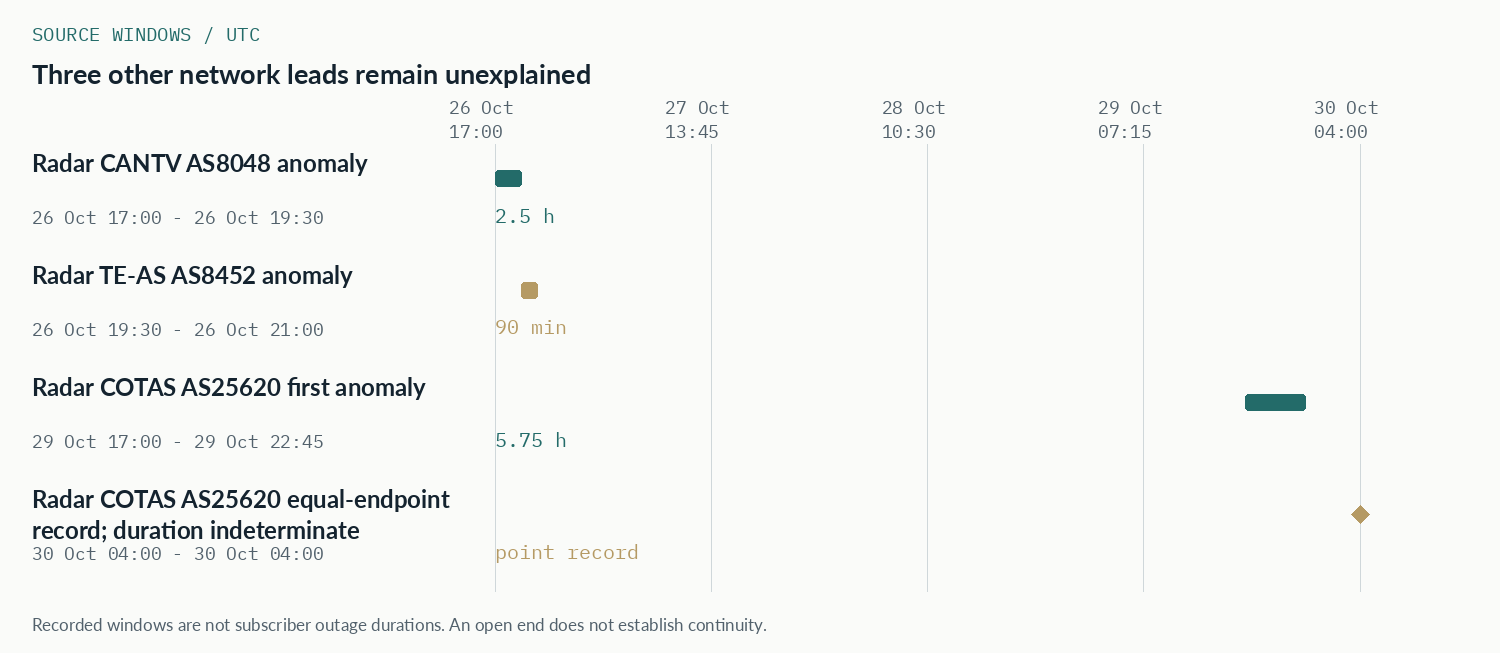
The archive contains separate October 26 traffic anomalies for CANTV and Telecom Egypt’s TE-AS, lasting two and a half hours and 90 minutes respectively. COTAS has a five-hour-45-minute record on October 29, followed by an October 30 record with identical start and end timestamps. That last record supplies no usable outage duration and must not be described as a zero-minute outage. [1]
Targeted public-source searches did not locate an event-specific operator explanation or original report securely matching these windows. They therefore remain separate, cause-unconfirmed leads grouped for follow-up. The unanswered questions are whether customers lost connectivity, where any impact occurred, and whether COTAS’s later timestamp represents another episode or a recording artifact. [1]
What remains unresolved
- What caused the CANTV AS8048 anomaly, and which customers or locations experienced disruption?
- What caused the TE-AS AS8452 anomaly, and was its full recorded interval associated with customer service loss?
- Does the COTAS AS25620 record at 04:00 UTC on October 30 represent a separate incident or a recording artifact?
- A consulted Telecom Egypt complaint-summary page concerns reports around '12:02AM EEST' on October 26, outside the archived evening anomaly. It is not treated as confirmation of this event.
- The countries attached to these networks are registration references: Venezuela, Egypt and Bolivia. They do not prove national impact.
- All four records carry Radar's VERIFIED label, but none contains a cause. Verification labels are not independent explanations.
- No shared cause is asserted across these networks, and no unrelated same-country reporting is used to explain them.
Sources and evidence
1. Cloudflare: Cloudflare Radar Outage Center. Supports: Evidence origin for all four outage records and 12 anomalies in the supplied archive. Event details and windows come from that archive; the public page was consulted, but its dynamic historical records were not independently re-extracted. Linked Radar X posts could not be fetched. [1]
2. Georgia Tech Internet Intelligence Lab: IODA internet outage monitoring. Supports: Evidence origin for the supplied archived active-probing confirmation in Guyana and absence of matching country alerts in Bangladesh and Peru. The public application was consulted; exact historical series were not independently re-extracted. [2]
3. Guyana Standard, reproducing Guyana Power and Light: GPL statement on the October 30 transmission-line trip (2026-10-30). Supports: GPL's original statement as reproduced: approximate 08:12 trip, Grove-Sophia line, earth fault, inspection findings and unverified suspicion of deliberate interference. [3]
4. La Caribeña News: Report preserving GPL’s October 30 ministry notice (2026-10-30). Supports: Reported utility-notice timestamp of 9.51am Guyana time, listed affected areas and absent restoration estimate. Page showed an update dated November 1; unrelated political and economic commentary is not adopted. [4]
5. Kominotek: Digicel describes damaged links and repair-access difficulties (2026-10-28). Supports: Reporting of Jean-Philippe Brun's October 27 and 28 communications about two damaged international links on RN1, insecurity delaying access and the lack of an initial restoration estimate. [5]
6. RL News Haiti: Digicel’s account of fiber damage and Wednesday restoration (2026-10-30). Supports: Operator account of October 27 damage around 13 h, an earlier damaged link, Wednesday restoration and difficulties with communications, work and financial services. Responsibility claims remain attributed. [6]
7. Bangladesh Sangbad Sangstha: Electricity board chairman explains Dhaka and Chattogram interruption (2026-10-27). Supports: Named official's explanation involving the Meghnaghat-Haripur line, affected locations and an approximately one-hour electricity interruption. [7]
8. Dhaka Stream: Grid restoration followed by gradual recovery of supply (2026-10-27). Supports: PGCB statement reported as onset at 12:43pm and grid restoration at 2:30pm, followed by phased generation and distribution recovery. Timezone is not explicit. [8]
9. bdnews24.com: Investigation into Bangladesh’s grid collapse (2026-10-27). Supports: Reporting of an investigation and a six-hour electricity outage, retained separately from shorter restoration accounts. [9]
10. The Business Standard: Electricity official describes gradual generation recovery (2026-10-27). Supports: Named BPDB official's account of generation returning in phases and expected improvement around 10pm, which is a forecast rather than a confirmed endpoint. [10]
11. Your Power Setup: Secondary account flags conflicting transmission restoration times. Supports: Consulted search-indexed text reports 13:40 and 14:30 local restoration accounts. The earlier time was not verified in an original statement and appears only as an unresolved research discrepancy. [11]
12. Infobae: Enosa reports northern Peru transmission disconnections (2026-11-01). Supports: Enosa's reported 15:03 power onset, named transmission lines, northern geographic scope and coordination with COES. No detailed initiating cause or complete restoration deadline was supplied. [12]
13. Correo: Correo’s November 1 archive identifies another transmission line (2026-11-01). Supports: Archive summary identifies L-5008 Nueva Chimbote-Trujillo and a 3:03 p. m. electricity interruption. Used only to preserve the unresolved infrastructure detail. [13]
14. Ejecentral: Customer complaints and Totalplay acknowledgment on October 28 (2026-10-28). Supports: Reports of connection problems involving Totalplay and izzi, complaint-based geographic information, and a reported Totalplay acknowledgment without a technical cause or final restoration time. [14]
15. Fontanka: VK acknowledges a data-center attack and says services remain available (2026-10-18). Supports: Pre-week context: VK's quoted statement acknowledging a physical attack while asserting normal service availability, alongside reported user complaints. Does not establish continuous impact. [15]
16. GeoCables: GeoCables’ October 29 Camtel signal. Supports: Published Camtel signal window of October 29, 12:50 to 14:10 UTC, and measurement caveats. Its heuristic cause labels and population extrapolations are not adopted. [16]
17. DesignTAXI Community: Telecom Egypt complaint summary outside the archived window. Supports: Research exclusion: describes complaints around 12:02AM EEST on October 26, which do not match the archived evening anomaly. Not used as confirmation of that event. [17]
Method and reporting window
This issue covers records overlapping 2026-10-26T00:00:00.000Z through 2026-11-02T00:00:00.000Z, with the end excluded. The evidence snapshot was assembled at 2026-11-02T13:00:09.058Z. Continuing events can appear in adjacent issues.
Signal Atlas compares public measurements; it does not operate its own probes. IODA country-level connectivity checks use a three-hour margin around the relevant record window. Multiple IODA sensors are one organisation. News reporting can supply context without becoming another independent internet measurement. Traffic anomalies can overlap outage reports and must not be added as separate confirmed incidents.